

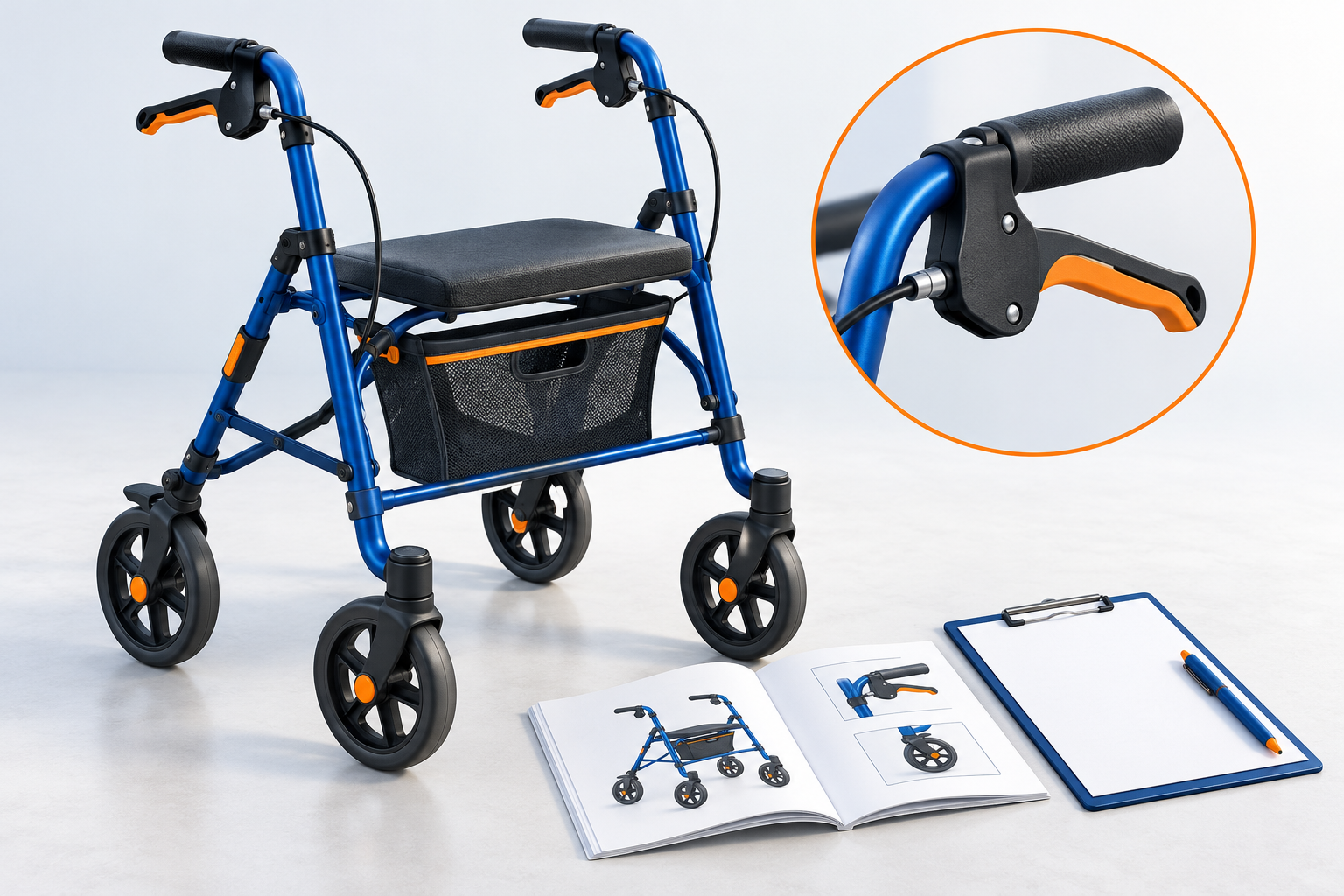
Two questions, not simply “it has brakes”
When handing over a rollator, it is easy to focus on wheels, handle height or folding the frame and reduce braking to “everything works”. Responsible acceptance needs more. Do not merely identify a control: distinguish how this particular device is slowed while moving from how it is held in its parking position. These are not interchangeable entries in a description.
This article proposes a handover preparation process, not a universal walking technique or brake-adjustment procedure. Individual suitability and any need for assistance should be considered separately with an appropriate professional. Demonstrated actions must follow the instructions for the actual model and version supplied, rather than a similar product in a photograph.
Match the model and version first
Bring the device, delivery documents and instructions together. Record the model name, version designation and any identifier provided on the equipment itself. A name on an invoice may not identify the controls fitted. Ask the supplier to show where that exact configuration is described in the documentation.
Do not use another rollator’s photograph as a guide to pressing, locking or releasing a lever. If handles, cables or catches differ from those in the supplied instructions, clarify the match instead of inventing a “similar” sequence. Keep a link or copy of the relevant document edition with the handover record.
Why there is no “universal lever” lesson
A concrete manufacturer example: the Rollz Flex manual distinguishes versions with classic brakes and flip brakes. Even a product-family name is therefore insufficient to select the correct explanation of its controls. [1]
A useful acceptance table has two rows: “slowing” and “parking lock”. For each, the supplier identifies the relevant manual page and demonstrates the action on the delivered device. Do not add your own pressing directions, forces or slope angles. Figures and procedures must come from the documentation, not an assumption that all rollators work alike.
Agree how the demonstration will happen
Before the meeting, ask who will demonstrate the equipment, in which language and how much time is allowed for questions. Clarify whether handover includes checking both braking functions, explaining how their state is recognised, and explaining what to do if a fault occurs. Agree these practical arrangements before delivery, not after the packaging has been cleared away.
Do not turn an introduction into an improvised test on a slope, with extra weight, or in a situation where someone depends on the device for support. The instructions and a competent supplier representative should define demonstration and checking conditions. If a mechanism’s operation is doubtful, do not compensate by changing grip or tightening parts yourself.
Record the outcome, not just a signature
Provide separate fields in a short handover record for model, instruction edition, date, demonstrator and observations. For service braking and parking, note exactly what was explained and checked. “Familiarised with equipment” will not help anyone later establish whether parking was demonstrated or only ordinary slowing.
Write observations rather than diagnoses: for example, “locking method needs clarification” or “supplier asked about mechanism operation”. Do not identify a fault’s cause without examination. Add the service contact and agreed next step. An unresolved observation should not disappear from the document merely because delivery is complete.
Where possible, agree how an answer will be provided: written clarification, another demonstration or inspection by a service specialist. The point is not paperwork volume, but being able to return to a specific question and establish whether it is resolved. Do not mark a check complete when it has only been promised for later.
What should remain after handover
The minimum useful package is the correct instructions, a clear explanation of both functions, a technical contact and a record of any outstanding questions. For a later handover to another person, do not rely on the previous user’s verbal account: reconsider documentation compatibility and the need for a technical check.
A well-documented handover cannot guarantee the absence of all risk or replace later maintenance. It establishes a practical distinction between what is confirmed for this unit, what was demonstrated under its instructions, and what still needs clarification. An equipment information page then becomes a verifiable set of questions, not a promise of universal safety.
Source and scope
Source checked on 25 October 2026 at 19:59 UTC. The manual confirms different Rollz Flex brake versions; the handover documentation workflow is an editorial checklist. This article does not replace the instructions for a specific device or individual assessment of its use.