

Start with the intended task
Ask the responsible healthcare professional to define who needs the device and why. Record these requirements separately from preferences for a screen, case colour or carrying bag. “For home use” does not mean that every device suits every person.
Leave room in the enquiry for an exact model, the manufacturer’s intended use, sensor type, supplied items and required documents. Mark unknown information as a question to resolve, rather than a confirmed feature.
A sensor is part of the verification
For the Nonin PalmSAT 2500, the manufacturer requires checking monitor, sensor and accessory compatibility and specifies Nonin PureLight sensors. This is one manual’s requirement, not a compatibility rule for other models. [1]
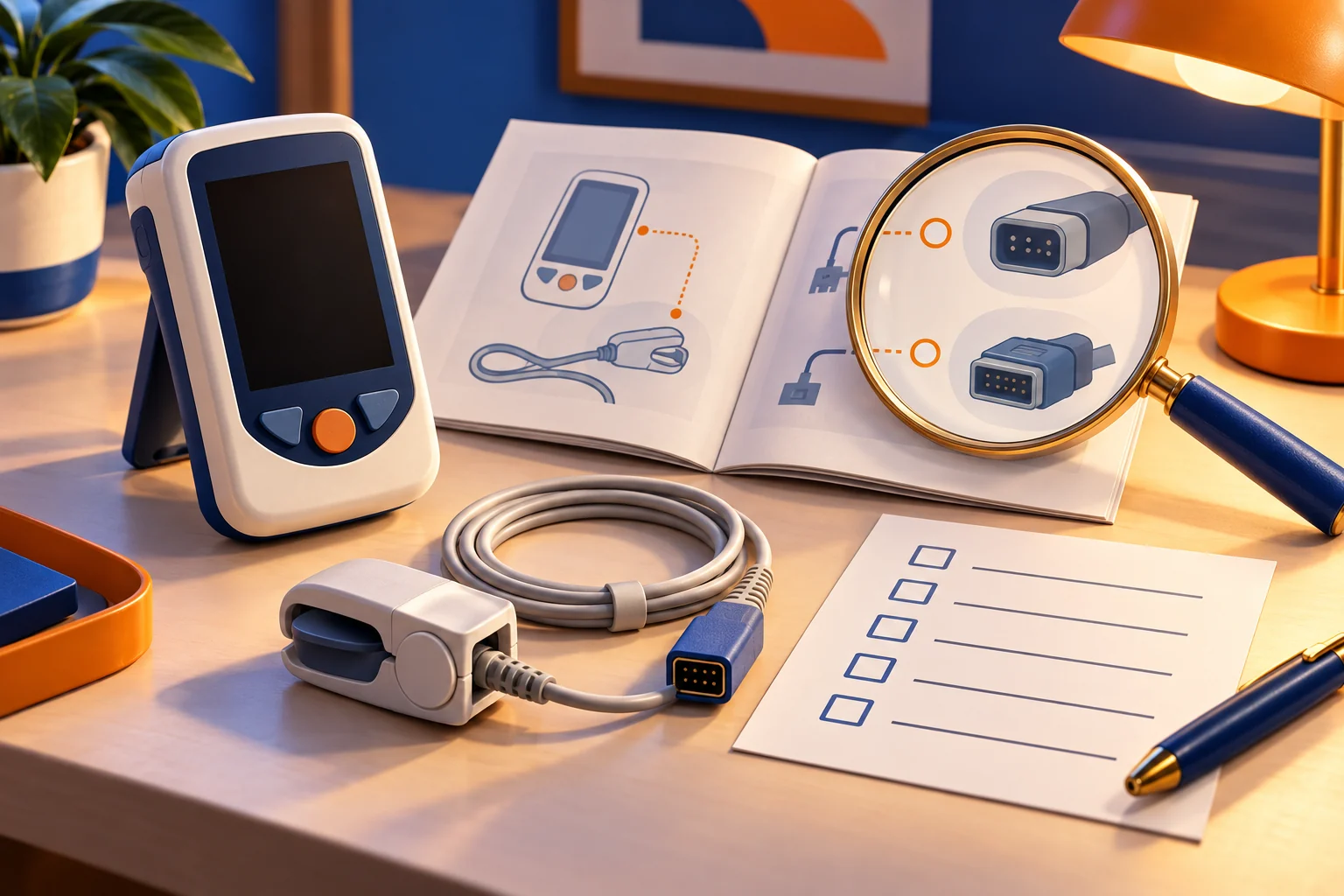
A useful quotation names the sensor manufacturer and exact part number and identifies a document that lists the intended device. A similar plug or connector photograph is not that confirmation. Do not test an unknown accessory by plugging it in experimentally.
Five lines for comparing quotations
- Device: exact model and the instruction-manual version supporting the proposal.
- Sensor: part number, stated intended use and compatibility documentation.
- Contents: included items, separately ordered extras, required power supply and cables.
- Support: how to obtain instructions, order an appropriate replacement accessory and raise questions.
- Delivery: confirmed timing, price for this precise package and unresolved conditions.
Place answers in matching columns. Do not fill an unconfirmed entry with information from another model. This makes the comparison intelligible before agreeing to a purchase.
One number does not describe a person’s condition
A pulse oximeter estimates blood oxygen saturation. FDA warns that readings may be inaccurate; circulation, skin pigmentation and nail polish are among the influencing factors. [2]
Movement, incorrect sensor positioning and external light can also affect measurement. MHRA stresses that SpO₂ does not measure carbon dioxide. [3]
Do not make your own treatment decisions from a number in a promotional image. Discuss the specific device instructions and an individual monitoring plan with a healthcare professional. Seek medical help for serious or rapidly worsening symptoms, even if a reading appears reassuring.
What to prepare before an enquiry
If seeking an accessory, photograph the existing device label without including personal medical information. Add the sensor part number and relevant manual page. For a new package, send the agreed requirements and request a written list of every supplied item.
FORMED® is an information catalogue. Nonin is mentioned as an example of consulting a primary source, not as confirmation of sale, stock or package contents. This article does not replace manufacturer instructions or professional medical advice.