

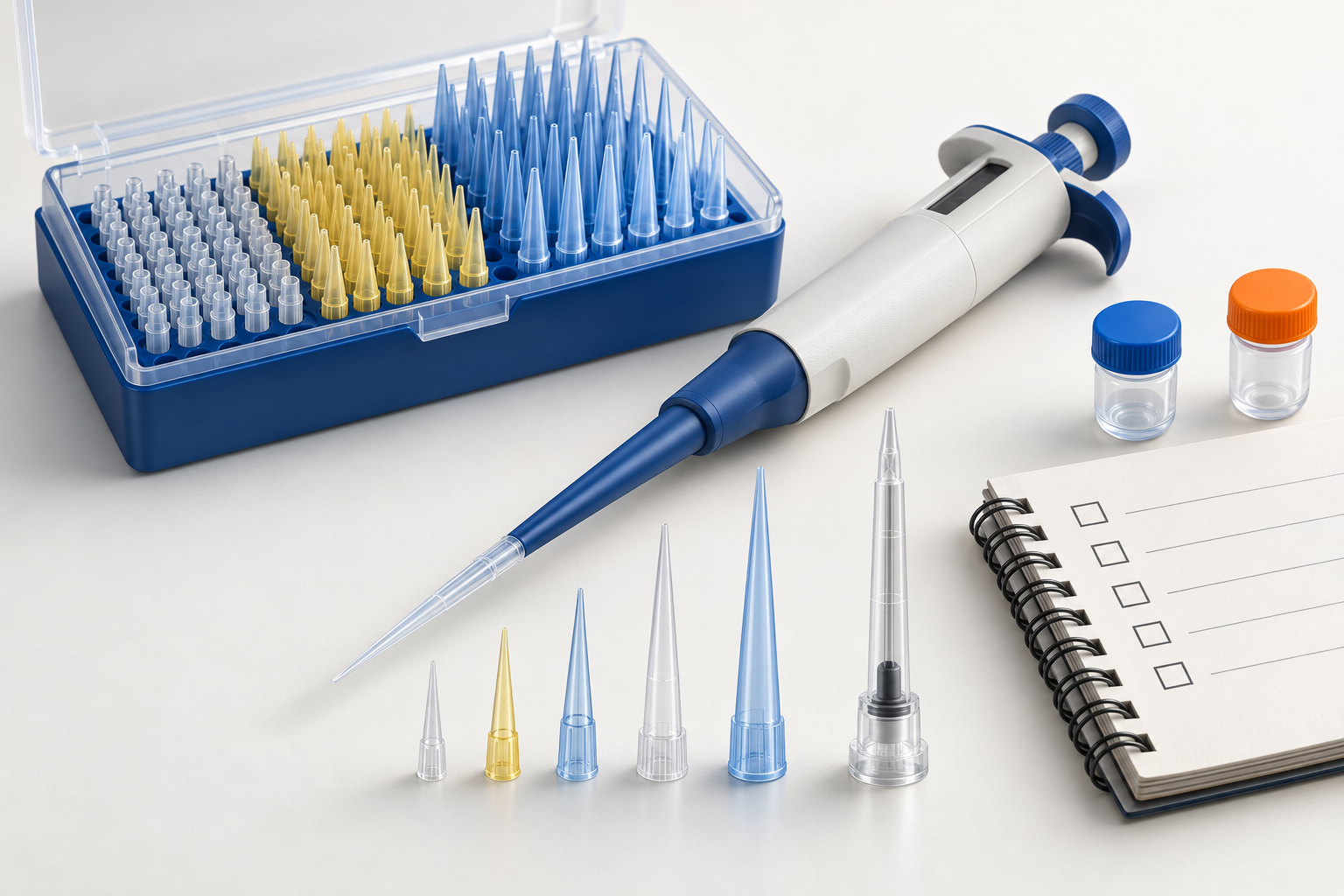
Matching volume ranges do not make two pipettes interchangeable. A useful supplier enquiry describes not just the instrument, but also the liquid, consumables and how the proposed set will be checked. This is an editorial purchasing checklist, not a laboratory operating procedure.
Start with the task, not the tip colour
Record the working volumes, liquid type, vessel format and number of repeated transfers. Identify who approves the method and cleanliness requirements. If information is missing, leave it as an explicit question rather than replacing it with a supplier’s assumption.
For example, “a pipette with a set of tips” leaves the set undefined. A more useful request is: “We need a set for our listed working volumes; please identify the exact instrument model, compatible tip reference and supporting documents.”
Two principles, different questions
An air cushion separates the piston from the liquid. In positive displacement, the piston inside the tip contacts the liquid. Eppendorf explains this distinction in User Guide No. 22, page 2. [1]
The principle alone does not select a particular set. Ask the responsible specialist to compare your task with that exact model’s documentation; this article does not establish suitability for a particular substance.
Five lines in the supplier enquiry
- Instrument: manufacturer, model, range and required working volumes, not just the highest number on its body.
- Tips: exact reference, pack format and documented compatibility with the selected model.
- Method requirements: required consumable properties and the documents supporting them.
- Checks and service: supplied documents, responsibility for checks before introduction into use and a contact for questions.
- Delivery: distinguish the instrument, initial tip supply, optional accessories and items excluded from the offer.
Compare sets, not a single price
Put quotations into a table with matching rows. If one supplier includes consumables and another does not, flag the difference before comparing totals. Base planned stock on your own workload rather than a universal quantity taken from promotional copy.
An explicit “not confirmed” status is more useful than a blank cell: it shows which questions remain open. Colour, visual resemblance or the generic word “universal” is not documentation of compatibility for a specific pair.
Before approval
Return to the original task: is the exact instrument named, is the tip identified, and is the delivery scope clear? If not, request clarification before approving the purchase. Operating techniques, checks and safety measures are governed by the current manufacturer instructions and the laboratory’s approved procedures.
FORMED VIP is an informational catalogue. This article does not confirm availability, price, compatibility or supplied accessories for a particular pipette; these must be agreed for the exact model.
Source and scope
Checked on 25 October 2026. The source supports the two-principle explanation; the purchasing checklist is an editorial suggestion.