

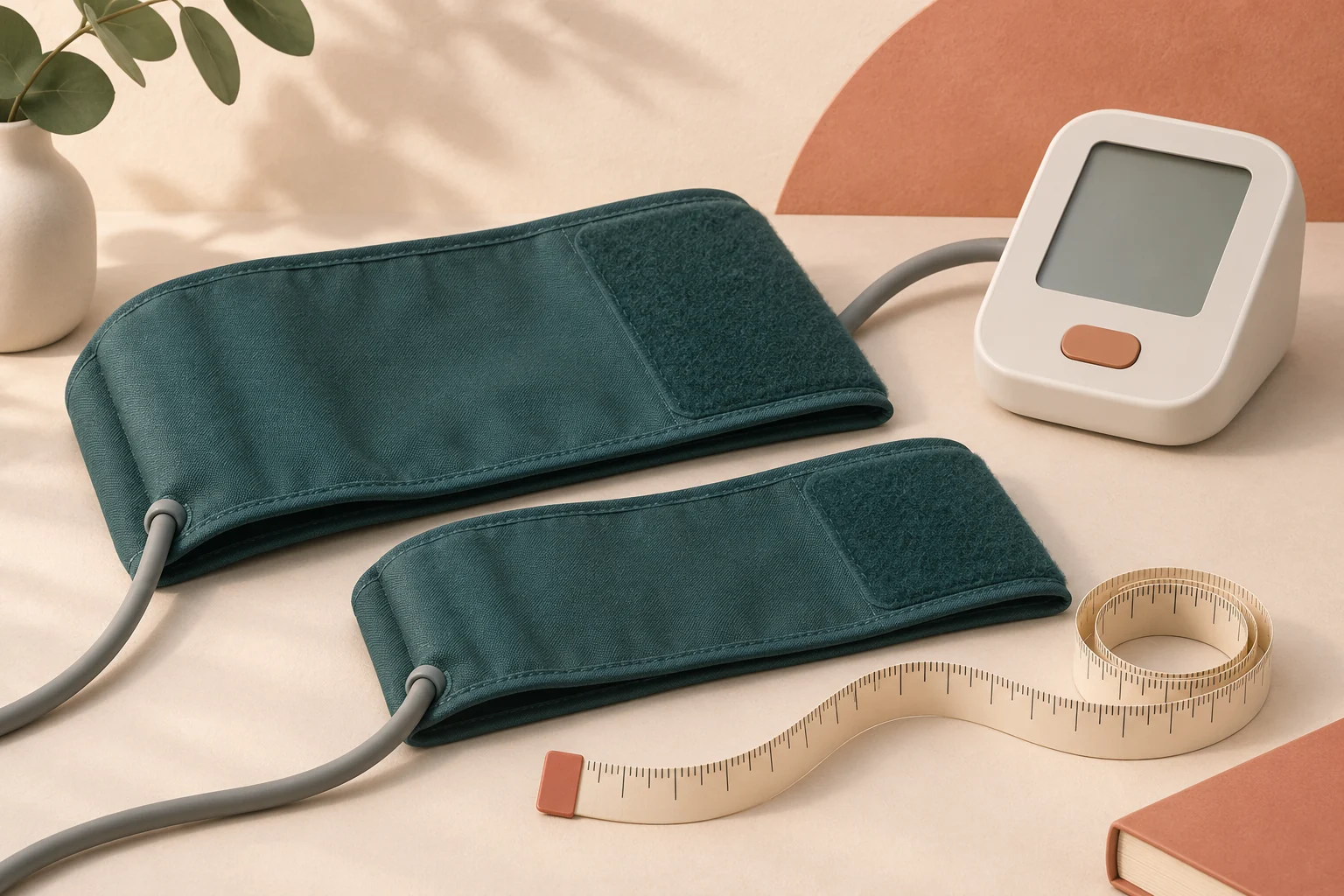
The quotation names an exact blood pressure monitor, but describes its cuff only as “adult”. This is a good point to pause and ask questions. Screens, memory and phone connections are easy to compare in a catalogue. Whether the cuff fits its intended user may remain unchecked until the box is opened.
This editorial purchasing checklist helps you specify an upper-arm monitor kit for a home or facility. It is not a blood pressure measurement protocol.
A letter is not a size specification
A study of validated home blood pressure monitors available in the US found inconsistent cuff-size terminology between manufacturers. An “L” label alone is therefore insufficient. Shahi and colleagues’ study.
Give the cuff its own fields in the enquiry: name, part number, supported arm circumference and compatible monitor models. “Universal” also needs clarification. Which circumference range and which version does it describe?
The American Heart Association advises choosing a cuff for the measured upper-arm circumference; an incorrect size can distort readings. AHA guidance.
Three checks before ordering
- Size. Request the circumference range from the instructions for the actual cuff offered. Do not transfer a size chart from another brand or series.
- Compatibility. Ask for confirmation of the exact monitor model and cuff part number as a pair. A photograph of a similar connector does not settle this. Check tubing, connectors and any adapters against the manufacturer’s documentation rather than choosing them by appearance.
- Contents. Establish which cuff is included in the price and which is an optional extra. For a facility, record the replacement part number and care requirements at the same time.
Ask the supplier to put the answers in one response with the relevant manual pages. This keeps the specification together instead of scattering it across a product description, messages and an invoice.
What to look for in a validated-device list
STRIDE BP records allow checks of the specific model, intended setting and population; some entries also list validated cuff sizes. STRIDE BP device list.
Open the entry for the exact model designation rather than stopping at a familiar manufacturer’s logo. If the required version is missing or the information is unclear, request supporting documents and an explanation. Absence from one database does not by itself establish that a device is unsuitable. Seek professional advice when choosing for children, pregnancy or other special populations.
A simple example that exposes a gap
Suppose a kit contains a cuff labelled for 22–32 cm and the required circumference is 34 cm. The order already has an unresolved question: a documented compatible alternative cuff or a different kit is needed. These are illustrative numbers, not FORMED® product specifications or an individual fitting recommendation.
If two people will use the monitor, account for both circumferences in the enquiry. Do not assume that “for the whole family” answers the sizing question.
A request you can send to the supplier
“Please confirm cuff part number ___ for monitor model ___, its supported upper-arm circumference range of ___–___ cm, and the document establishing compatibility. State whether the cuff, tubing and required connectors are included in the price, and provide the replacement part number and care instructions.”
On receipt, compare the labelling, contents and manual with the agreed order. Learn how to use and fit the equipment from its instructions with a healthcare professional’s help. Check cleaning separately: read the instructions before choosing a cleaning agent.
For questions about a kit, contact FORMED® with the model and required circumference range. Availability and compatibility of a particular version require confirmation.
Scope: general purchasing information. This article does not establish a diagnosis, target pressure, measurement schedule or treatment. Do not change prescribed treatment yourself. External sources do not endorse the FORMED® catalogue.