
Start with the working batch, not litres
A quick incubator comparison can reduce the decision to price and chamber volume. Procurement needs a different question: can your actual batch be accommodated in a configuration permitted for the specific equipment? Chamber volume, shelf count and the number of vessels in a routine cycle are different measures. Do not automatically translate one into another.
Describe both the usual batch and the largest planned batch. List vessel types, external dimensions including lids, quantities and required holders. Give each format a separate line. This turns “everything should fit” into a requirement that a supplier can meaningfully review.
Separate geometry from permitted loading
Request internal chamber dimensions, usable dimensions of inserts and a list of compatible shelves. Establish whether the stated shelf count describes the supplied set or the maximum possible configuration. Confirm weight limits separately: a geometrically suitable shelf does not establish that the proposed load is permissible.
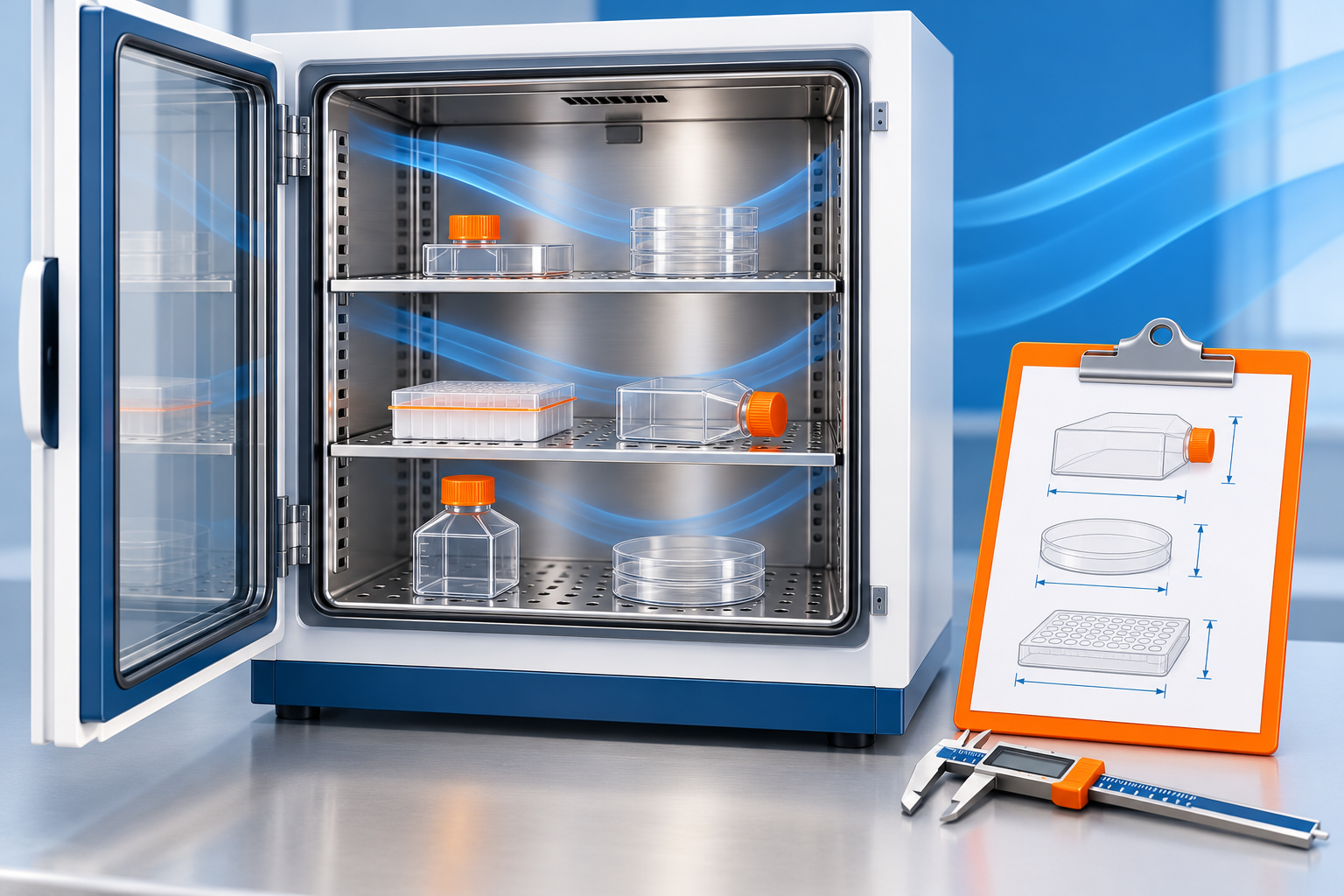
Include a simple arrangement sketch with vessel dimensions. It is neither permission to operate nor a replacement for the manual. Its purpose is to make the real configuration discussable, including vessel removal and space for any monitoring equipment required by the laboratory procedure.
Use the specific manufacturer’s manual
For example, the Memmert IN/IF manual cautions against dense loading and separately specifies shelf counts and load limits. This is series-specific guidance, not a universal layout. [1]
Ask the specialist to identify the document sections supporting the proposed arrangement. Do not transfer clearances, settings or restrictions from another model because the chambers look alike. Keep the exact equipment version and manual revision in the correspondence so everyone reviews the same configuration.
Compare complete configurations, not cabinets
Separate the appliance, supplied shelves, extra inserts and holders in the quotation. Request a part number, quantity and compatibility confirmation for each item. Mark what is included and what costs extra. This makes differences between apparently similar offers visible without assumptions.
If an accessory is substituted, revisit the agreed arrangement. Similar dimensions alone do not prove equivalence. Ask how the substitution affects available space and conditions of use. An unresolved point should remain explicit in the specification rather than disappear behind the word “equivalent”.
Define acceptance before delivery
Agree who checks the delivered set, approves the arrangement and takes responsibility for the laboratory’s required checks. A working display and a closed door do not establish suitability for the intended batch. If assessment with representative loading is required, a competent specialist should define its conditions and criteria under the laboratory’s procedure.
Do not replace that assessment with an improvised test. The procurement document can identify the check’s purpose, responsible person, required records and response to a discrepancy. This article does not prescribe temperatures, durations, material suitability or monitoring methods.
A concise procurement brief
A useful brief contains five elements: vessel and batch lists, an arrangement sketch, the exact accessory set, the selected version’s manual and an agreed acceptance process. When the supplier replies, check that every open question received a specific answer rather than a general assurance that it will fit.
For FORMED VIP, this supports equipment selection without claiming that any incubator of a particular volume will meet a laboratory’s needs. Availability, supplied accessories and delivery remain subject to confirmation. The illustration explains planning; it is not an actual model or an approved loading diagram.
Source and scope
Source checked on 25 October 2026 at 21:44 UTC. The example concerns Memmert IN/IF; the procurement checklist is editorial guidance. This article does not replace the selected version’s manual or laboratory procedures.